
If your AC is running but not cooling, the most common causes include a dirty air filter, low refrigerant from a leak, frozen evaporator coils, dirty condenser coils, a failing capacitor, or blocked ductwork. In Delaware County, PA homes, high summer humidity and older housing stock make these problems especially likely. Most issues require a licensed HVAC technician to diagnose and fix safely. Turn the system off if you notice warm air or ice on the unit, and call a professional before the problem damages the compressor.
There is a particular kind of frustration that hits when you walk inside on a sweltering August afternoon, hear your air conditioner humming away, and realise the house is still warm. The system is clearly on. The fan is blowing. But the air coming out of the vents is barely cool — maybe slightly less hot than outside, but nowhere close to comfortable. If you live in Havertown, Springfield, Drexel Hill, or anywhere else in Delaware County, you have likely experienced this at least once.
The fact that your high-efficiency air conditioners can develop this problem even after years of reliable service catches a lot of homeowners off guard. The system sounds like it’s working. The thermostat is set correctly. But something is clearly wrong. Understanding what causes this, and what your options are, can save you time, money, and a lot of sweaty evenings.
Why Delaware County Homes Are Especially Vulnerable
Before getting into the specific mechanical causes, it’s worth understanding why this region puts particular stress on cooling systems. Delaware County sits squarely in what the Pennsylvania State Climatologist describes as the southeastern coastal plain and Piedmont Plateau climate zone, an area that regularly sees temperatures above 90°F for roughly 25 days each summer, with prolonged oppressive stretches from July through mid-September.
The bigger challenge here is not just the heat. It’s the humidity. Unlike drier climates where cooling the air is relatively straightforward, your AC in this part of Pennsylvania has to simultaneously lower the temperature and pull significant moisture out of the air. That double workload strains the compressor and evaporator coil in ways that homeowners in drier regions don’t experience at the same rate. Add to that Delaware County’s aging housing stock — many homes in Havertown, Swarthmore, and Upper Darby were built before modern duct sealing and insulation standards, and you have a recipe for cooling problems.
The Most Common Reasons Your AC Is Running but Not Cooling
1. Dirty or Clogged Air Filter
This is the single most frequent cause, and it’s often the first thing to check. When the air filter gets clogged with dust, pet hair, and allergens, airflow across the evaporator coil drops significantly. Less air moving across that coil means the system can’t absorb heat from your home efficiently, so air conditioner not blowing cold air becomes the result even though the unit is technically operating. Filters in most Delaware County homes should be replaced every 30 to 90 days, but it’s easy to forget, especially in winter when the AC isn’t running.
2. Low Refrigerant From a Leak
Refrigerant is the chemical that physically carries heat from inside your home to the outdoor unit. It doesn’t get “used up” like fuel — so if your system is low on refrigerant, it’s almost always because of a leak somewhere in the coil or refrigerant lines. A system running with low refrigerant will keep blowing air, but that air will barely feel cool. You may also notice ice forming on the refrigerant lines near the indoor unit. This is a job that requires a licensed HVAC technician — handling refrigerant is federally regulated, and no amount of DIY troubleshooting will fix a leak that needs to be found, sealed, and properly recharged.
Homeowners with older systems should pay particular attention here. If your AC was manufactured before 2010, it very likely uses R-22 refrigerant, which the EPA permanently banned from production and import as of January 1, 2020. Servicing an R-22 leak today means paying a premium for reclaimed refrigerant that grows scarcer and more expensive every year. In many cases, the more financially sound decision is to replace the system entirely.
3. Frozen Evaporator Coils
The evaporator coil inside your air handler needs warm air moving across it continuously to function. When airflow drops usually because of a dirty filter or low refrigerant, the coil temperature drops too far and moisture in the air freezes on the coil surface. Once ice builds up, heat exchange stops almost entirely, and your air conditioner not blowing cold air becomes complete. The system keeps running but can’t cool anything because the coil is essentially encased in ice.
If you suspect frozen coils, turn the system off and let it thaw for a few hours before calling for service. Running a frozen system doesn’t help and can damage the compressor.

4. Dirty Condenser Coils Outdoors
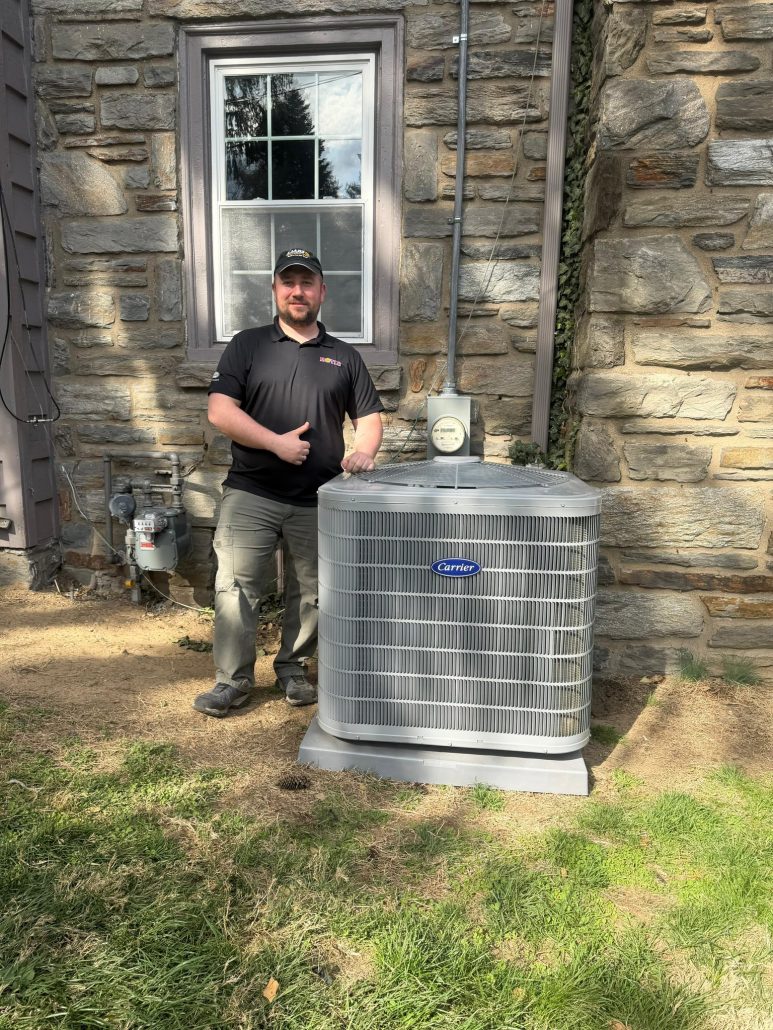
The outdoor unit — that big metal box sitting next to your house is where your AC releases the heat it pulled from inside. The condenser coil does that job, and it does it by pulling outdoor air across thin metal fins. In Delaware County, those fins collect pollen during spring, cottonwood seeds in early summer, grass clippings after mowing, and general dust throughout the season. When the fins clog up, the system can’t shed heat properly. The result is that heat builds up in the refrigerant loop and your home stops cooling down, even though everything sounds normal from inside.
Keeping a couple of feet of clearance around your outdoor unit and gently rinsing the coils once per season helps, but a professional cleaning gets the fins properly cleared without bending them.
If you are dealing with any of these symptoms right now and are not sure where to start, the team at Boyle Energy in Havertown can walk you through it. They serve Delaware County, Chester County, Montgomery County, and Philadelphia, and their number is +1 610-595-4685. A quick call can often help you determine whether it is something simple or whether a technician needs to come out.
5. Failing Capacitor or Contactor
This one tricks a lot of homeowners. The capacitor is an electrical component that gives the compressor and fan motors a jolt of electricity to start running. When a capacitor starts to fail, the compressor may not start even though the fan still runs. From inside the house, it sounds like your AC is working fine the air handler is blowing, the outdoor unit is humming — but the compressor isn’t actually pumping refrigerant. No refrigerant movement means no cooling, period.
Capacitors are one of the most commonly replaced components in AC systems older than five to seven years, especially in systems that work hard through Delaware County summers. Replacement is a straightforward job for a licensed technician but should not be attempted as DIY due to the risk of electrical shock.
6. Ductwork Leaks or Blockages
A lot of Delaware County homes were built in the 1950s, 60s, and 70s with ductwork that has never been inspected since installation. Over decades, duct joints separate, flex ducts develop kinks, and in some cases, pests create damage. When a significant portion of your conditioned air leaks into unconditioned attic or crawl space before it reaches your living areas, the ac is running but not cooling situation is actually a distribution problem, not a mechanical one. The U.S. Department of Energy estimates that duct leakage accounts for up to 30% of cooling energy loss in typical homes. If rooms at the far end of the house are consistently warmer than rooms near the air handler, leaky ducts are worth investigating.
7. Thermostat Malfunctions or Miscalibration
Smart thermostats and programmable units add convenience, but they also introduce more points of potential failure. A thermostat that is miscalibrated reads the room temperature inaccurately, which can cause the system to cycle off before the home actually reaches the set temperature. A thermostat that has a loose wiring connection may not communicate properly with the outdoor unit, meaning the compressor never gets the signal to run even though the fan does.
Check that the thermostat is set to “cool,” that the temperature is set at least three to five degrees below the current room temperature, and that the fan is on “auto” rather than “on.” If those settings are correct and the problem persists, the thermostat itself may need professional evaluation.
8. Wrong System Size for the Home
This comes up more often than homeowners expect, especially after a renovation, a home addition, or when a replacement system was sized using rough approximations rather than a proper load calculation. An oversized system cools the thermostat sensor area quickly and shuts off, but it never fully circulates air through the whole house or removes enough humidity. The result is an uncomfortable, clammy home even when the AC ran recently. An undersized system, on the other hand, simply cannot overcome the heat gain during peak summer temperatures and runs non-stop without ever hitting the target temperature.
Proper sizing requires a Manual J load calculation that accounts for your home’s square footage, insulation quality, window area, and local climate data. Getting this right matters particularly for air conditioning installation in older Delaware County homes where insulation and window types vary significantly from one property to the next.
9. Age and Compressor Decline
HVAC systems have a practical lifespan of 15 to 20 years. A system approaching or past that range will gradually lose efficiency, even if no single component has failed. The compressor the heart of the refrigeration cycle works hardest of all, and it degrades over years of cycling on and off through Delaware County’s hot, humid summers. Reduced compressor capacity means reduced cooling capacity, and eventually the system just can’t keep up.
The Value of Staying Ahead of Problems
The majority of the issues listed above could be caught early or prevented altogether with a scheduled air conditioning tune-up before the cooling season starts. A proper tune-up covers refrigerant level verification, electrical component testing, coil cleaning, drain line flushing, and a full system performance check. For a system that’s worked hard over recent summers, this is the equivalent of changing the oil before a long road trip inexpensive insurance against a breakdown when you need the system most.
Skipping maintenance is particularly costly in this region. A system that is already straining under high humidity and heat loads has almost no margin for an ignored problem to stay manageable. A slightly low refrigerant charge in May becomes a completely frozen coil by July.
When It’s Time to Call a Professional
Some of this checking the filter, confirming thermostat settings, clearing debris around the outdoor unit — you can handle yourself. But anything involving refrigerant, electrical components, or internal coil access needs a licensed HVAC technician. Running a system with frozen coils or a failing compressor doesn’t just leave you uncomfortable; it can turn a manageable repair into a full system replacement.
Frequently Asked Questions
- Why is my AC running but not blowing cold air?
The most common reasons are a dirty air filter blocking airflow, low refrigerant from a leak, a failing capacitor that prevents the compressor from starting, or frozen evaporator coils. Start by checking and replacing your filter. If that doesn’t resolve it, call a licensed HVAC technician to diagnose the refrigerant charge and electrical components. - Can I run my AC if it’s not cooling?
It’s not recommended. Running an AC with frozen coils or low refrigerant places extreme stress on the compressor, which is the most expensive component to replace. Turn the system off and call for service. If coils are frozen, let the system thaw with the fan on “fan only” mode for a few hours before the technician arrives. - How do I know if my AC is low on refrigerant?
Signs include warm or only slightly cool air from the vents, ice forming on the refrigerant lines near the indoor unit, a longer run time than usual, and higher electric bills. Refrigerant doesn’t deplete naturally, so low levels always indicate a leak that needs to be found and repaired by a licensed technician. - Why does my AC run constantly but not cool the house?
Continuous running without reaching the target temperature usually points to one of three issues: the system is undersized for the home, there are significant duct leaks losing conditioned air before it reaches living spaces, or the refrigerant charge is too low to handle the full cooling load. A proper system inspection and load evaluation will identify which problem applies. - How often should I replace my AC filter in the summer?
In Delaware County during summer, once per month is reasonable for most homes. Homes with pets, allergies, or renovation activity should check the filter every two to three weeks. A clogged filter is the fastest path to frozen coils and poor cooling performance, and replacement filters are inexpensive. - My AC is blowing air but it’s not cold, is the compressor broken?
Not necessarily. Before assuming compressor failure, check the air filter, confirm the thermostat settings, and inspect the outdoor unit for ice or debris. A failing capacitor — which is far less expensive to replace — can mimic compressor failure by preventing the compressor from starting while the fan still runs. A technician can test both components quickly. - Why is one room in my house much warmer than the rest?
Hot spots in specific rooms typically indicate a ductwork problem, either a disconnected joint, a kinked flex duct, or a blocked register in that room. It can also happen when a system is oversized and short-cycles, never distributing air evenly. A duct inspection and possibly duct sealing or balancing can usually resolve this. - At what age should I replace my AC instead of repairing it?
A general guideline is that if a system is over 10 to 12 years old and faces a repair costing more than half the price of a new unit, replacement is usually the better financial decision. Systems older than 15 years that use R-22 refrigerant should almost always be replaced rather than repaired, given the scarcity and cost of reclaimed R-22 and the improved efficiency available in modern systems.
If your AC is running but not cooling and the basic checks haven’t solved it, reach out to Boyle Energy. They’ve been serving homes across Havertown, Delaware County, Chester County, Montgomery County, and Philadelphia, and they can diagnose what’s actually going on rather than guessing. Call them at +1 610-595-4685 to schedule a service visit before the peak of summer arrives.

Patrick Boyle brings over three decades of expertise to Boyle Energy, carrying forward a family legacy that began with his grandfather, Joseph Boyle Sr., the company’s founder. With extensive technical proficiency, Patrick holds advanced certifications in both oil and HVAC systems, ensuring the highest standards of service and performance. Additionally, he is recognized as an NPGA-certified propane service professional, underscoring his commitment to safety and industry best practices. Under his leadership, Boyle Energy continues to deliver reliable and efficient energy solutions, grounded in generations of trust and innovation.