 Skip to content
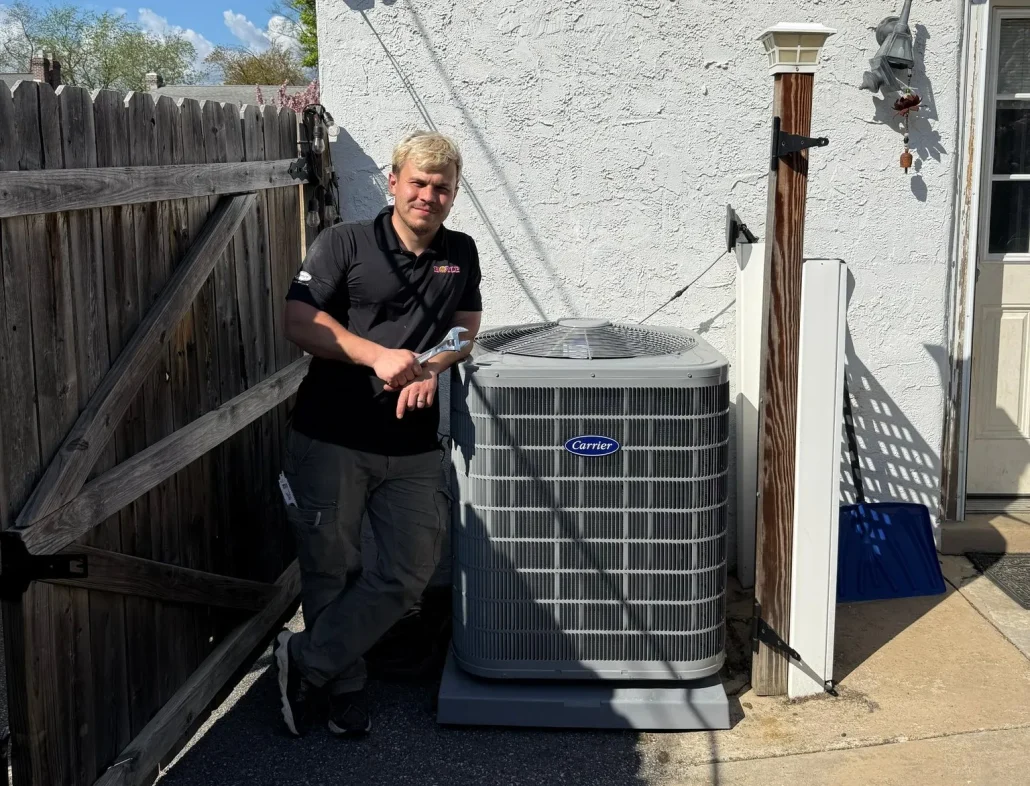
For most Philadelphia-area homeowners, central AC is the better choice when you already have working ductwork and need whole-home cooling across multiple rooms. A ductless mini split is the smarter option for older rowhouses, homes without ducts, room additions, or anyone who wants room-by-room temperature control. In Delaware County and Montgomery County, both systems perform reliably in the region’s humid summers, but the right fit depends on your home’s structure, size, and how you actually use your living space. Neither system is universally superior. The answer lives in the specifics of your home.
If you’ve spent any time researching home cooling this spring, you’ve probably landed on the same big question that most Philadelphia-area homeowners eventually hit: central AC or ductless mini split? It sounds like a simple comparison, but the more you dig, the more variables show up. Ductwork, efficiency ratings, upfront costs, rebates, room layouts, your neighbor says one thing, the internet says another. When people looking into air conditioning installation in Havertown or nearby suburbs ask us this question, our honest answer is always: it depends on what your house actually is. Let’s walk through what that means in practical terms.
How Central AC and Ductless Mini Splits Actually Work
Central air conditioning is probably the system you grew up with. An outdoor condenser unit sits beside your home, an indoor air handler connects to it, and a network of ducts pushes cooled air through vents in every room. One thermostat, one set temperature, one system managing the whole house. It works elegantly in homes designed for it. The challenge in the Philadelphia region is that a large share of the housing stock, especially the pre-1940 rowhouses and attached colonials that define so much of Delaware County and South Philly, was never designed for ductwork at all.
A ductless mini split skips the ducts entirely. You have the same outdoor compressor, but instead of feeding air through walls and ceilings, it connects via refrigerant lines to one or more wall-mounted indoor units. Each indoor unit handles its own zone independently. You can cool the master bedroom without running the living room unit. You can let the guest room sit warmer while keeping the home office at 68°F. The system that handles installation of air conditioning system in Delaware County, PA in a 1920s brick colonial and the system that works best in a 2005 four-bedroom suburban build in Havertown are not necessarily the same system.
Central AC vs Mini Split: What Makes Them Different for Philly Homes
When comparing central ac vs mini split for the Philadelphia climate, the first thing worth understanding is what the weather actually demands. This region falls into Climate Zone 5A, which means summer design temperatures can hit 91°F with serious humidity. Philadelphia summers are not just hot. They’re heavy. An AC system here has to remove moisture from the air just as much as it lowers the temperature. A system that cycles on and off frequently, as older single-speed central AC units tend to do, doesn’t run long enough per cycle to pull adequate moisture from the air. That’s why homes with undersized or inefficient central AC can still feel clammy even when the thermostat looks fine.
Modern mini split systems use variable-speed inverter compressors. They don’t blast on at full power, then shut off. They modulate output up and down based on what the room actually needs, running longer at lower speeds. That extended runtime is exactly what pulls humidity out of Philadelphia’s sticky summer air. It’s one of the reasons ductless systems tend to handle the region’s latent heat load so well.
Duct efficiency is another real-world factor that often gets overlooked in the ductless ac vs central air debate. A central air system in an older home where ducts run through unconditioned attics or crawl spaces can lose 20–30% of cooled air through leaks and thermal losses before it ever reaches a room. You’re paying to cool your attic. Mini splits eliminate that loss entirely.
If you’re not sure which system makes sense for your home and budget, the team at Boyle Energy has been helping Delaware County, Montgomery County, and Philadelphia homeowners with exactly this decision since 1937. Reach out at 610-595-4717 (suburbs) or 215-703-2363 (Philadelphia) for assessment. No pressure, no sales pitch, just an honest conversation about your home.
What Type of Home Is Each System Best For?
Answering central AC vs. mini split gets much easier once you factor in home type.
Central AC is the stronger choice when the home already has ductwork in decent condition, when you’re cooling five or more rooms and want seamless whole-home temperature consistency, or when you’re replacing an existing central system and the infrastructure is already in place. Larger newer builds in Chester County and Montgomery County suburbs, where homes were designed with forced-air systems, are generally good candidates. Central air also tends to be more visually seamless since there are no wall-mounted units in individual rooms.
Ductless mini-splits are the practical choice in four situations that show up constantly in the Philadelphia market. First, older homes without existing ductwork, including the area’s abundant pre-1940 brick colonials and rowhouses, where installing full duct runs would require opening walls and ceilings. Second, room additions, sunrooms, converted garages, and finished basements that simply aren’t connected to the existing HVAC system. Third, multi-family conversions or homes where different occupants have genuinely different temperature preferences. Fourth, homeowners who want a dual-function system, because most mini splits operate as heat pumps too, handling both cooling and heating from one unit.
The practical middle ground that more Havertown and Delaware County homeowners are landing on lately is a hybrid approach: keep the existing central system for main living areas if the ductwork is serviceable, and add a mini split for problem zones like the upstairs primary bedroom, a finished basement, or a new addition. You don’t always have to choose one or the other for the entire house.

Cost Comparison of Minisplit Ductless AC vs. Central Air: What to Expect in the Philadelphia Market
On the ductless AC vs. central air cost question, the numbers depend heavily on your starting point. If your home already has functioning ductwork, a central AC installation in the Philadelphia area typically runs $4,500 to $12,000 for equipment and labor. If ductwork needs to be added from scratch, that figure climbs substantially.
A single-zone mini split installation generally runs $2,500 to $5,000 all-in. Multi-zone systems covering a whole home range from $10,000 to $18,000, depending on how many indoor units are needed and how complex the line routing is. Northeast labor rates run roughly 20–40% above the national average, so quotes in the Philadelphia suburbs will reflect that. One Pennsylvania homeowner reported receiving quotes of $9,000 for a single-zone setup, so getting multiple bids from licensed local contractors matters.
Long-term operating costs favor mini splits in most comparisons. Homeowners typically see 20–40% lower energy bills compared to traditional central AC, primarily because there’s no duct loss and the inverter technology is inherently more efficient. Annual maintenance is also simpler and less expensive since there’s no ductwork to clean or seal.
Rebates and Incentives Available to Havertown and Philadelphia-Area Homeowners
It’s worth knowing the current incentive landscape before you make a purchase decision. The federal Section 25C tax credit for heat pumps and central AC systems expired on December 31, 2025. There are no federal tax credits for these installations in 2026.
What remains available is the PECO Act 129 rebate program, which covers the five-county Philadelphia metro area. PECO customers who install qualifying heat pump or mini split heat pump systems can access tiered rebates, and stacking them with EAP (Electrical Association of Philadelphia) bonuses can push combined incentives above $1,700. Phase IV rebates run through May 31, 2026, with Phase V beginning June 1, 2026 under recently approved PA PUC guidelines. For the most current rebate amounts and eligibility requirements, the PECO rebates page is the authoritative source. A good local contractor should walk you through what you’re eligible for before the job starts.
So Which One Is Right for Your Philadelphia Home?
In the central ac vs mini split debate, there genuinely isn’t a universal winner. What there is, is a system that fits your specific home better than the other. If you have solid existing ductwork, a larger multi-room home, and you want whole-house consistency without wall-mounted units, central AC is probably your path. If you’re in an older home without ducts, dealing with problem rooms the existing system can’t handle, or you want the efficiency and zoning flexibility of independent room control, a ductless mini split is almost certainly the smarter investment.
The humidity piece matters more than most people realize. Whatever system you install in the Philadelphia area needs to handle latent heat removal effectively, not just temperature reduction. That alone is a reason to work with an HVAC contractor who understands regional conditions and doesn’t just spec the cheapest unit that fits the square footage.
Boyle Energy has been in the business of keeping Philadelphia and Delaware County homes comfortable since 1937. If you want someone who will walk through your home, look at what you actually have, and give you an honest recommendation rather than a sales pitch, give us a call at 610-595-4717 (suburbs) or 215-703-2363 (Philadelphia). You can also reach us at info@boyleenergy.net or visit us at 40 W Manoa Rd, Havertown, PA 19083. We serve homeowners across Delaware County, Chester County, Montgomery County, and Philadelphia, and we’re available 24/7.
Frequently Asked Questions
- Is central AC or a mini split better for an older Philadelphia rowhouse?
For most older Philadelphia rowhouses without existing ductwork, a ductless mini split is the more practical and cost-effective option. Retrofitting full ductwork into a pre-1940 brick rowhouse typically requires opening walls and ceilings, which is expensive and disruptive. A mini split requires only a small hole for the refrigerant line and can be installed in a single day per zone. - How much does it cost to install a mini split in Delaware County, PA?A single-zone mini split installation in Delaware County typically runs $2,500 to $5,000 for equipment and labor. Multi-zone whole-home systems can range from $10,000 to $18,000. Northeast labor rates are higher than the national average, so always get at least two or three quotes from licensed local contractors.
- Can a ductless mini split handle Philadelphia’s humidity?Yes, and in many cases better than a traditional central AC system. Mini splits use variable-speed inverter compressors that run in longer, slower cycles, which is what actually removes moisture from the air. Philadelphia’s humid summers demand a system that handles latent heat effectively, not just air temperature.
- What rebates are available for AC installation in the Philadelphia area in 2026?The federal Section 25C tax credit expired December 31, 2025 and is no longer available. PECO customers in the Philadelphia metro area can still access Act 129 utility rebates, with stacked EAP bonuses potentially exceeding $1,700 for qualifying heat pump or mini split heat pump systems. Phase IV runs through May 31, 2026, and Phase V begins June 1, 2026.
- What are the pros and cons of central AC vs mini split for a suburban Philadelphia home?Central AC pros: whole-home consistency, no visible wall units, ideal if ductwork already exists. Central AC cons: duct losses, single thermostat controls the whole house, expensive to add ducts in older homes. Mini split pros: no ductwork needed, room-by-room control, highly efficient, doubles as a heater. Mini split cons: higher upfront cost in multi-zone setups, visible wall-mounted units, each zone requires its own indoor unit.
- Does a mini split work well in Philadelphia winters too?Most modern mini splits function as heat pumps, providing both cooling and heating. Many cold-climate models operate efficiently down to 0°F or below, which covers Philadelphia’s winter design temperatures. This dual-function capability makes them particularly practical for homeowners who want one system for year-round comfort.
- How do I know if my existing ductwork is good enough for central AC?A qualified HVAC technician should inspect your ducts before any new central AC installation. Key things they’ll check include the condition of joints and seals, insulation in unconditioned spaces, proper sizing, and whether the system is balanced. Leaky or undersized ducts can offset much of the efficiency of even a high-rated new AC unit.
- Which system is more energy-efficient, central AC or a ductless mini split? Ductless mini splits are generally more energy-efficient, particularly in homes without existing ductwork. They eliminate duct losses, which can waste 20–30% of cooled air in older homes, and their inverter compressor technology adjusts output to actual demand rather than cycling on and off at full capacity. Most homeowners see 20–40% lower cooling costs compared to older central AC systems.
Not Sure Which AC System Fits Your Home?
Every home is different. Call Boyle Energy today for expert guidance on choosing between central AC and a ductless mini split. We’ll assess your home, explain your options, and recommend the best cooling solution with no pressure.

Patrick Boyle brings over three decades of expertise to Boyle Energy, carrying forward a family legacy that began with his grandfather, Joseph Boyle Sr., the company’s founder. With extensive technical proficiency, Patrick holds advanced certifications in both oil and HVAC systems, ensuring the highest standards of service and performance. Additionally, he is recognized as an NPGA-certified propane service professional, underscoring his commitment to safety and industry best practices. Under his leadership, Boyle Energy continues to deliver reliable and efficient energy solutions, grounded in generations of trust and innovation.
